
Reviewing the October Projects of the Zooniverse Challenge
The Zooniverse Challenge at Northeastern is a part of the crowdsourcing efforts of the Centers for Digital Scholarship. In December, there will be a crowdsourcing workshop open to Northeastern community faculty, staff, and students to learn more about Zooniverse, and how to start a Zooniverse project. As the intern for the CDS Crowdsourcing Initiative, I am creating documentation on how to establish Zooniverse projects at Northeastern, as well as developing a guide on crowdsourcing. The October theme for the Zooniverse Challenge is Outer Space. The suggested projects include: Rubin Comet Catchers, DELVE Dwarf Galaxy Quest: Milky Way Neighbors, Cosmic Collisions, Sunspot Detectives, Cloudspotting on Mars: Shapes.
Of the five suggested projects for this month, I chose to work on the Rubin Comet Catchers project based at the Vera C. Rubin Observatory in Chile. I chose this project because after testing out the other suggested projects it was the easiest for me to classify the subjects correctly. According to the project, the observatory uses the “largest digital camera built to conduct the largest astronomical survey ever attempted over a ten-year period.” This project focuses on discovering new comets in the first images from the observatory. It offers volunteers the chance to identify never-before-seen comets and look for comets hiding in plain sight. The data collected will be used to gain a deeper understanding of how planetary systems form and evolve.
The images presented to volunteers include both “training” images created from the Dark Energy Camera along with pictures from Rubin. The camera used is the Legacy Survey of Space and Time (LSST) camera which helps scientists study dark energy and matter. The training images appear frequently, but participants are not aware that they are viewing one. I find the training images helpful because they provide immediate feedback on whether I correctly identified the image. This Zooniverse project requires much more volunteer participation, as it is currently 0% complete. From participating in different Zooniverse projects, I have noticed that certain projects attract more volunteers than others depending on the subject matter. This project is easy to work on but I don’t think a lot of people are interested in this project on Zooniverse.
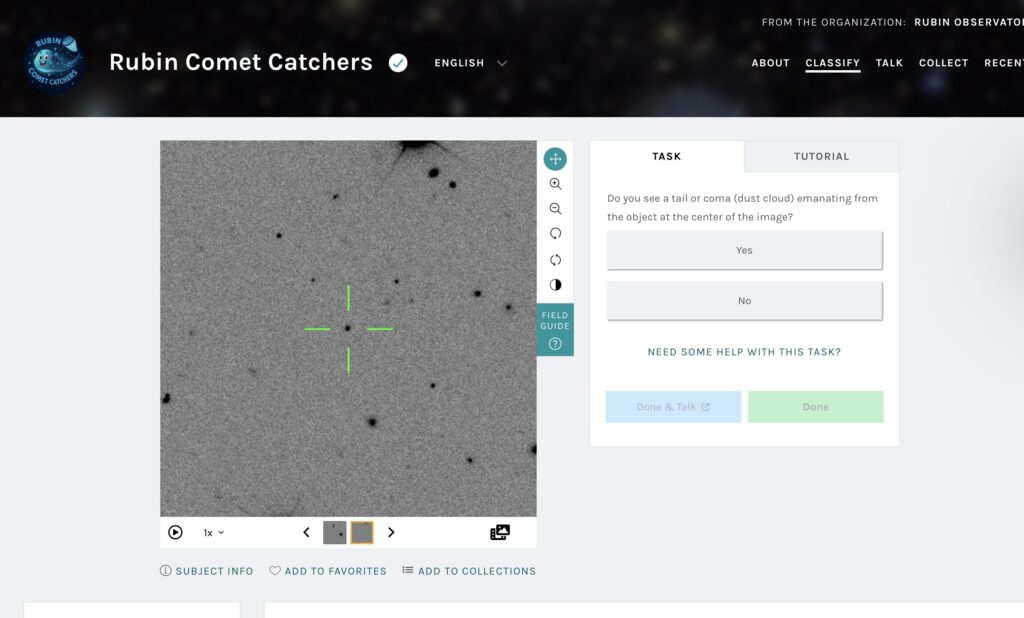
No prior experience or scientific background is needed to get started with this project. As a person who’s more interested in the social sciences than hard sciences, this month’s Zooniverse projects have been outside of my comfort zone. At times, I’ve questioned if I’m submitting correct answers, but the field guide is helpful to understand what I’m looking at. I appreciate the field guides for every project and would be lost without them. One of my favorite parts of Zooniverse projects is how I get to learn about subjects I normally wouldn’t if not for crowdsourcing.
After working on this project for less than an hour, I ran out of subjects to classify. When I returned later, more subjects were available, so that’s something to keep in mind. An August update banner states that these images are a part of a small dataset. The researchers expected the data to be classified quickly and the number of classifications per image is high to allow for more participation. It also allows for more accurate data if fielding from a number of responses.
Sunspot Detectives, another suggested project this month, looks at historical solar drawings to understand how the sun changes. The project is taking data from 19th-century drawings from the Collegio Romano Observatory in Rome. Zooniverse volunteers are looking at the drawings and counting how many spots they see. Since the 1600s, observers have used telescopes to sketch the Sun’s surface. These sketches reveal sunspots which are regions on the Sun with magnetic fields crucial to understanding the Sun’s magnetic behavior. The project is 96% complete and I find it exciting to contribute to projects that are close to completion. Make sure to submit the quick questionnaire for your chance to win a prize! For next month’s theme, we will be traveling back in time to The Past!