
CDS Student Showcase
On March 25, 2026, we were delighted to host our first CDS Student Showcase, co-sponsored by the Centers for Digital Scholarship and the Humanities Center, highlighting the work of undergrad and graduate students working for the CDS/HC projects! The work of the CDS and Humanities Center projects would not be possible without the labor and care of student colleagues. This hybrid event was an opportunity to celebrate these students.
The event featured a series of lightning talks, followed by a brief Q&A and an in-person reception. There were ten lightning talks that highlighted the scope of the work being undertaken in the CDS. Every project was represented, and the majority of the speakers were undergraduate students.
The first talk was by Kaylee Burkett and Lehna Fokum, undergraduate research assistants from Mapping Black London. They discussed their work building partnerships with two local parishes in London: St. George in the East & St. Annes Limehouse. Together they worked with the London Archives and other historical resource banks to discover, report, and expand on Black stories related to the local parishes. The team is building an interactive physical exhibition for the local parish congregation and wider community.
Two graduate research assistants, Claire Lavarreda and Dipa Desai, spoke next about their work with the NULab for Digital Humanities and Computational Social Science. They detailed their work on reviewing the accessibility of the NULab website. Dipa highlighted the complexity of the WAVE Accessibility checker, and Claire detailed the process of identifying which issues were fixable and which were outside their control.
The Digital Transgender Archive (DTA) now has labs in the Boston, London, and Oakland campuses. Each lab gave its own presentation, beginning with a talk from Mark Burford and Sofia Zamora, undergraduate research assistants from the DTA Boston lab. They highlighted new collections being added to the project’s archive. These included the collection of Alexis Francois, a drag queen, hair stylist, and wig maker in San Francisco from the late 1960s to the early 2000s. They also highlighted HoMoVisiones, the first Latino LGBT public access television program in NYC. The London DTA lab was represented by Eleanor Brown, a PhD candidate at the London campus, who overviewed the new British artifacts being added to the DTA collection. Phaedra Powers-Miguel, an undergraduate research assistant, discussed their work at the Oakland DTA lab, including the process of scanning materials and the considerations around redacting. They underscored how the DTA’s policy on redaction is iterative and changes based on social considerations, such as the current political climate.
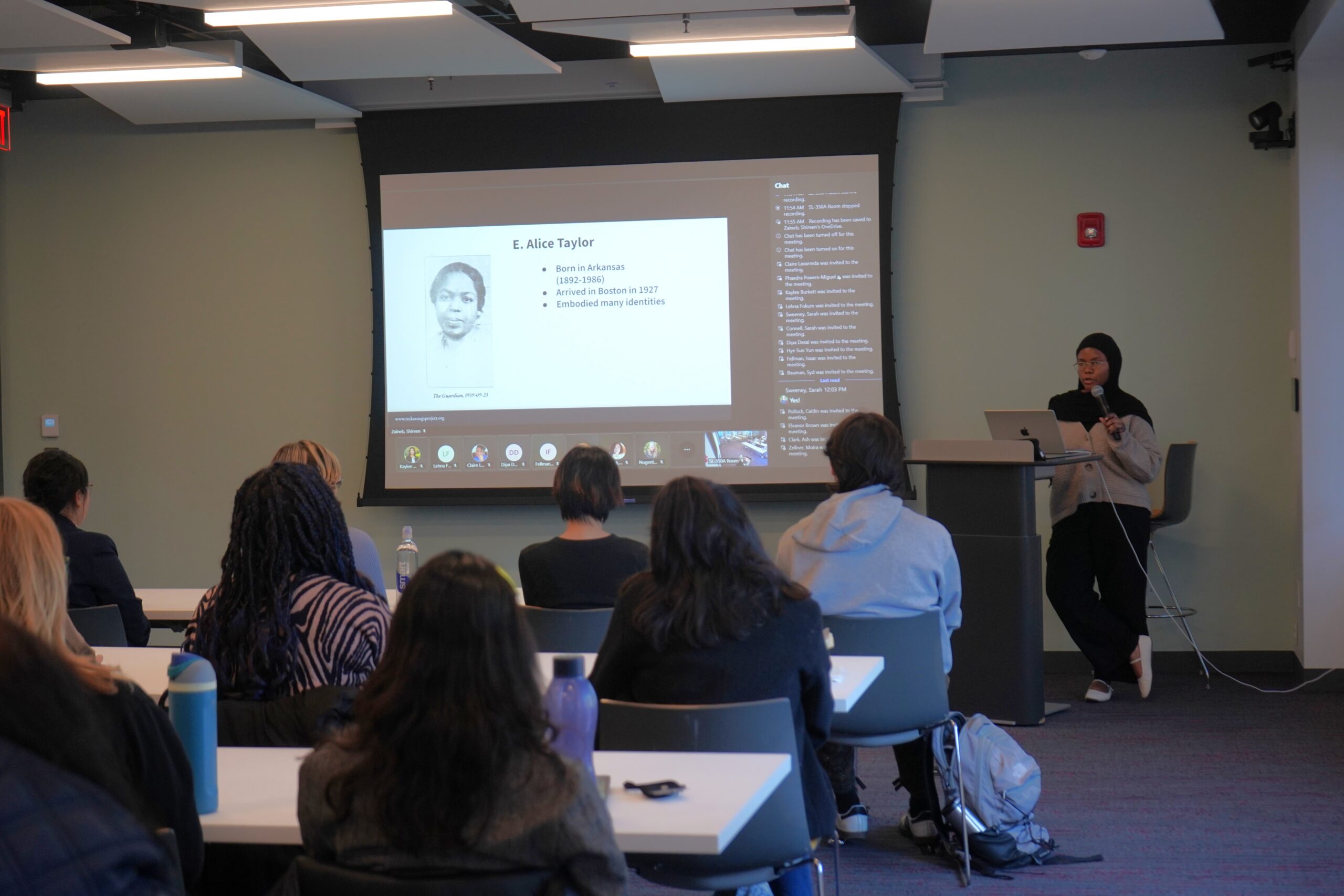
Following the trio of lightning talks by the DTA, Safia Ibrahim spoke about her work as an undergraduate research assistant for the Reckonings Project. Specifically, she discussed her research on the life of E. Alice Taylor, a beauty entrepreneur in Boston who founded a branch of Annie Malone’s Poro School and Beauty Shoppe. The Poro School established safe, effective products for Black hair and the Boston branch grew to be one of New England’s largest minority-owned businesses. Safia demonstrated how E. Alice Taylor’s legacy highlighted the power of building economic networks that can lift entire communities.
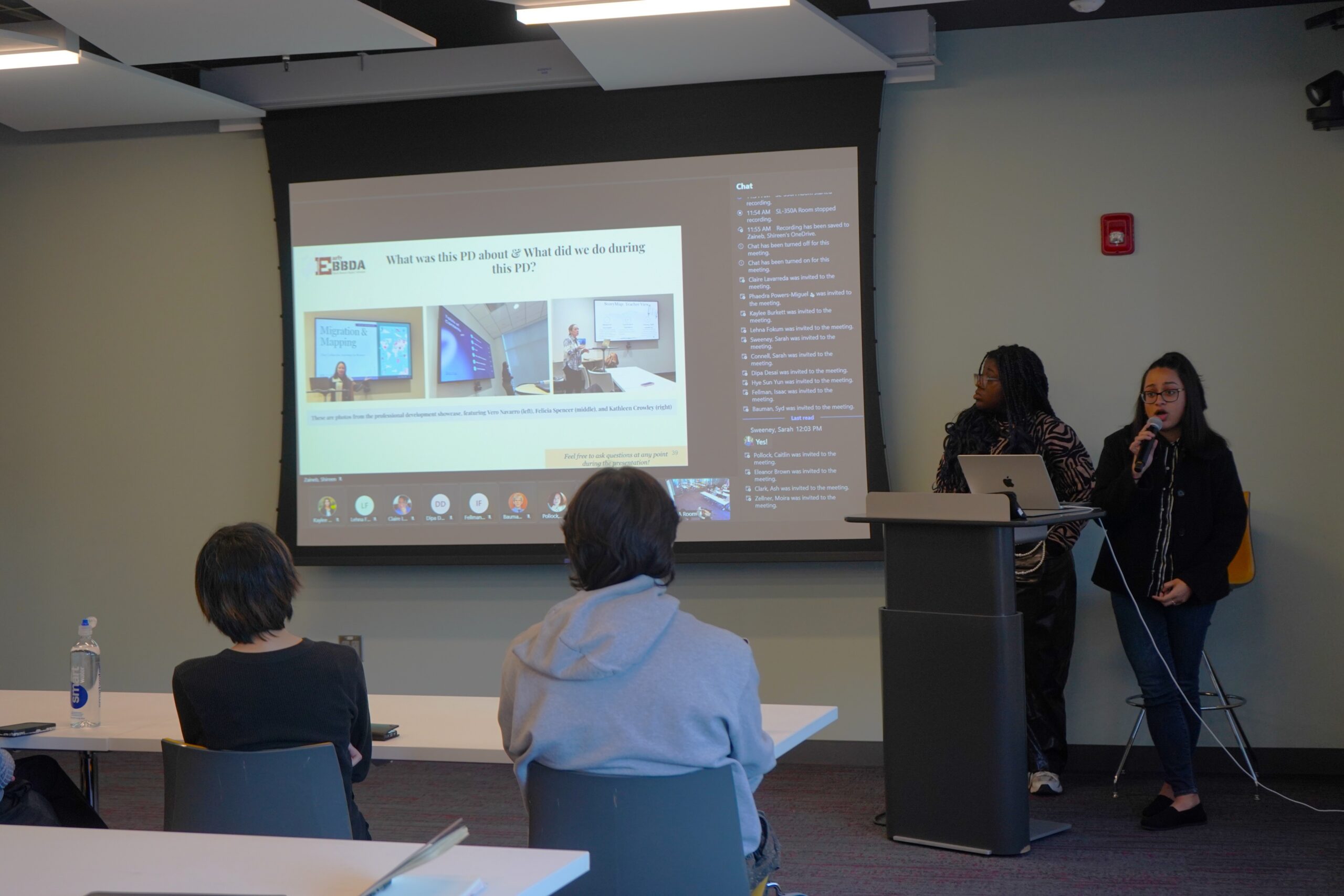
The Early Black Boston Digital Almanac (EBBDA) was represented by Gabrielle Paterson, an undergraduate research assistant, and Savita Maharaj, a PhD student and Project Manager of Early Black Boston Digital Almanac. They began by providing a brief overview of the project, which seeks to answer the question: how can we use digital technologies to tell more diverse narratives of Early Black Boston? Savita highlighted the project’s crowd-sourced digital exhibits created by undergraduate, graduate, and 8–12 grade students, as well as curriculum materials focused on using digital tools to tell these stories.
Gabrielle detailed the process of building the exhibit she has been working on, titled “Early Black Queer History in Boston.” She emphasized the importance of establishing metadata principles that detail how to enter the site and approach the materials. Savita also discussed a professional development workshop for Caribbean Cultural Studies in the 8–12 classroom in Boston Public Schools (BPS) that she led with Nicole Aljoe, the director of the EBBDA. This workshop provided insights into how digital tools can be used to help Boston students learn about Caribbean history, language and culture. Savita explained that ~25% of BPS students are of Caribbean descent, and the workshop aimed to provide inclusive and reflective engagement with the cultural backgrounds of these students.
The next talk was given by Alison Ye and Hailey Punis, undergraduate students who work for the Digital Archive of Indigenous Language Persistence (DAILP). Alison was the software engineering co-op at DAILP from July–December 2025, and has continued working on the project. She discussed her work adding new metadata fields in the backend and redesigning the metadata display. She showcased the new metadata editing window, which makes the editing workflow more flexible and keeps the interface consistent. Hailey, the DAILP Assistant Project Manager and Web Content Developer, discussed her recent work creating technical documentation for DAILP’s GitHub. She underscored how GitHub is central to DAILP’s mission to be an open source resource for developers, users, and tribal communities.
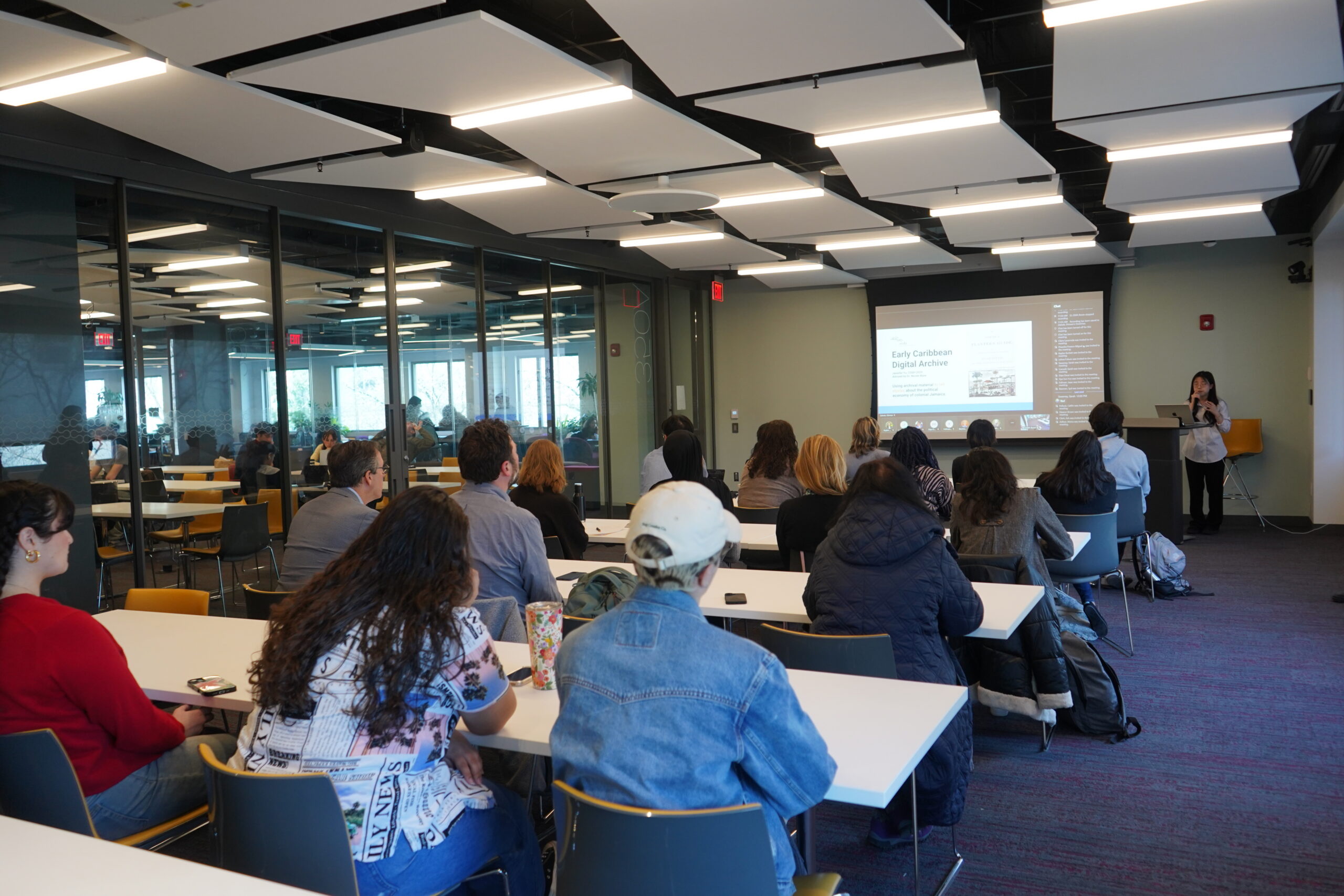
Jennifer Yu, an undergraduate research assistant, spoke next about her work at the Early Caribbean Digital Archive. She discussed her experience using archival material to tell stories about the political economy of colonial Jamaica. She emphasized digital archiving and digital humanities as essential tools for highlighting underrepresented histories.
The final lightning talk was by Vivica Dsouza, a graduate research assistant associated with the Center for Transformative Media. She discussed her research with John Wihbey about the use of AI within newsrooms and how its rapidly reshaping newsroom workflows, pointing out that there is very little research on how this change unfolds. She found that studying real-world newsrooms requires flexibility and that AI adoption is not just technical, but cultural and ethical as well.
Following the talks, there was a brief Q&A session. The highlight was when the students were asked to all describe their personal journeys that brought them to work for the various projects. The event concluded with an informal in-person reception in the CDS. If you are interested in learning more about the digital scholarship happenings at Northeastern, the CDS hosts regular events, which can be found on the CDS Events page.